

Nico Bignu
CEO of GEO Metrics
YouTube and GEO: How to optimize videos to be cited in AI search
YouTube and GEO: Why AI Cites Videos and How to Optimize Your Channel to Appear in ChatGPT, Perplexity and Google AI
YouTube is the fourth most cited source by artificial intelligence engines, appearing in 8.55% of responses generated by ChatGPT, Gemini, Perplexity, Claude and Google AI Mode (GEO Metrics data, 200,000 responses analyzed, April 2026). The main reason is technical: AI does not play back or analyze a video's audio — it only reads the associated text: transcripts, title, description and metadata. Optimizing those elements is the foundation of GEO for YouTube. |
Why YouTube Dominates AI Citation
When an SEO professional or content manager wonders why certain videos appear in AI responses while others don't, the answer has nothing to do with audiovisual quality. It's about text accessibility.
The language models powering tools like ChatGPT Search, Perplexity AI or Google AI Overviews cannot play back or analyze a video's audio in real time. What they can do is read the indexed text associated with that video: the automatic or manual transcript in the page's HTML, the title, description, timestamp titles and the Schema Markup of the website where the video is embedded.
YouTube holds a massive structural advantage over other platforms: it natively exposes that text in an indexable way. This is why, according to GEO Metrics' own data from 200,000 AI responses across eight engines between January and April 2026, youtube.com ranks fourth among the most cited domains, with an 8.55% share — behind only google.com (36.26%), wikipedia.org (15.68%) and reddit.com (11.07%).
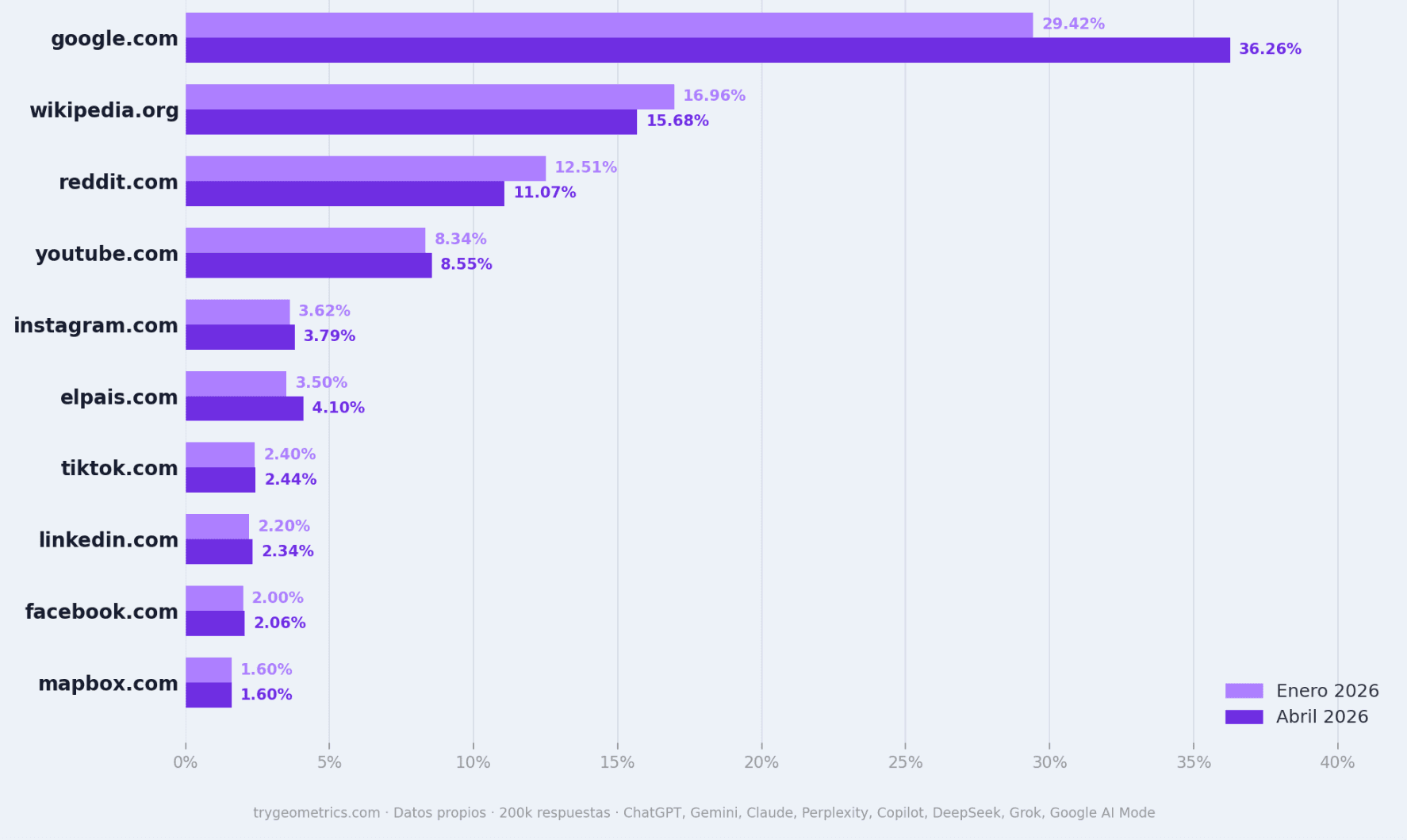
That makes YouTube a strategic AI visibility channel, not just a direct traffic source.
How AI Actually Reads a YouTube Video
Understanding the technical indexing architecture is the starting point for any YouTube GEO strategy.
What AI Does Read
Text transcript. The subtitle file — automatic or manual SRT — that YouTube exposes in the page's HTML. It is the primary citation source. If the transcript contains errors in brand names, figures or technical terms, the model may discard the video as an unreliable source.
Title, description and chapters. All the text surrounding the video is crawled before the transcript. Timestamp titles are especially important because they act as semantic headings that organize content for the AI crawler.
Metadata and Schema Markup. The JSON-LD on the web page where the video is embedded. If it includes the full transcript under the VideoObject type, the AI accesses it in a structured, deterministic way without relying on YouTube's dynamic HTML.
What AI Does Not Do
Play back or analyze the video's audio in real time
Watch frames or run OCR on what appears on screen
Process graphics, infographics or presentations shown in the video
Infer information not explicitly written in the transcript or metadata
Operational conclusion: if something is not written in the transcript or metadata, it does not exist for the AI — regardless of what happens in the video. |
Transcript Optimization: The Most Undervalued Asset in YouTube SEO
Most company or agency channels rely on YouTube's automatic subtitles. This is the most common technical mistake in video GEO.
Automatic subtitles have an error rate exceeding 10% for brand names, figures and technical terms. When AI finds a transcript with errors in those elements, it reduces confidence in the source and discards it in favor of alternatives with clean text.
The Four Transcript Optimization Techniques
1. Upload manually corrected SRT files. Don't rely on YouTube's automatic transcription for videos where your brand, product or key figures are mentioned. Export the automatic SRT, correct it, and re-upload it as a manual subtitle file.
2. Mention entities explicitly. AI models work with Named Entity Recognition (NER). Clearly pronouncing your full company name, product and category increases the probability that the model recognizes you as a named entity rather than generic text.
3. Use "Audio Bolding". Introduce a strategic pause just before and after a key statement. This pause acts as auditory punctuation for the model's language processor: the segment is semantically isolated and has a higher probability of being extracted as an independent citation.
4. Inject factual data every 2–3 minutes. Statistics, figures and specific percentages increase citation probability by 30–40%, according to a Princeton study on GEO. AI models cite what they cannot generate themselves. A proprietary, verifiable data point is, by definition, unciteable without attribution.
Immediate action: manually correct transcripts for your top 20 traffic-driving videos. This is the highest-impact-per-hour intervention in YouTube GEO. |
Script Architecture Designed for Citation
A GEO-optimized video script is not written just for the viewer. It is written for the model's semantic extractor. The principle is simple: design every video so the AI can extract self-contained information blocks that make sense independently.
Script Element | GEO Technique | Result in AI |
Opening (0–30 sec) | Define the core concept with direct, simple language | Generates featured snippets in Google AI Overviews |
Marked chapters | Timestamps with titles replicating real search queries | AI links to the exact second of the answer |
Factual data | At least 3 proprietary statistics in the first 60 sec | +40% probability of being selected as a factual source |
Nodal Conclusion | Final summary in spoken list format | Structured framework for AI to synthesize without ambiguity |
How to Name Video Chapters for GEO
The most common mistake is naming chapters with generic descriptive labels: "Introduction", "Part 1", "Conclusion". These titles carry no search intent.
The GEO alternative is to replace them with real questions users type into search engines: "What is GEO and how is it different from SEO?", "What's the best software to measure AI visibility?", "How do I know if AI is citing my brand?".
When Perplexity or ChatGPT receive that exact question, the engine finds a direct match between the query and the chapter title. This significantly increases the probability of citation with a timestamp.
Schema Markup VideoObject: The Technical Layer Most SEO Teams Ignore
VideoObject Schema Markup is the most powerful — and least implemented — mechanism for giving AI engines a deterministic source of truth about a video.
Critical technical fact: 69% of AI crawlers do not execute JavaScript. This means any Schema Markup loaded asynchronously or via JS is invisible to the majority of crawlers. The JSON-LD must be present in the initial server-rendered HTML (SSR), never injected via JavaScript. |
The Four Fields That Maximize Citability
VideoObject: transcript — Paste the full corrected transcript into the JSON-LD of the page where the video is embedded. This gives the AI structured access to the text without relying on YouTube's HTML.
VideoObject: hasPart (Clip) — Define each chapter with startOffset and endOffset, linked to the real user question that segment answers. This is the foundation of the Seek-to-Action feature used by Google AI Overviews and Perplexity.
Organization: sameAs — Link the YouTube channel to your company's LinkedIn profile, Crunchbase and Wikipedia. Connects digital entities and reinforces the model's knowledge graph.
interactionStatistic — Reports views and engagement. Allows the AI to distinguish genuine, validated content from bot-generated material.
Differentiated Strategy by AI Engine
The citation overlap between ChatGPT Search and Perplexity AI is only 11%. A one-size-fits-all strategy works well for one and poorly for the other.
Attribute | Google AI Overviews | Perplexity AI | ChatGPT Search |
Key factor | SEO Authority (E-E-A-T) | Recency + external citations | Semantic density and coherence |
Ideal format | Short clips · AI Clips | Technical reference sources | Tutorials and detailed guides |
Crawl speed | Days or weeks | Hours (social mentions) | Variable (Bing + direct crawl) |
Key action | Rank in YouTube Search first | Reddit traction on launch day | Consistency across blog, G2 and video |
The "Neighborhood of Trust": Cross-Platform Authority for GEO
In GEO, an entity mention without a link in a semantically relevant context carries equivalent weight to a backlink in traditional SEO.
Perplexity crawls Reddit almost in real time. Answer industry questions in relevant subreddits with your own data, mentioning the channel naturally. A mention in a relevant thread can generate citation within hours. | |
Wikipedia | Large language model knowledge graphs are strongly anchored in Wikipedia. Confirming your presence as a real entity and keeping your channel link updated reinforces named entity recognition. |
ChatGPT and Perplexity crawl LinkedIn to validate professional authority. High correlation with B2B citation. Share videos with a paragraph of unique data extracted from the content itself — not just the link. | |
Specialist Press | Industry publications act as 'truth witnesses' for LLMs. A mention in a specialist outlet activates E-E-A-T signals directly. Issue press releases with original proprietary statistics — they are the most cited data points. |
The GEO Metrics That Matter for YouTube
Traditional SEO metrics — impressions, clicks, CTR, average position — don't capture value generated in zero-click environments. In those environments, your brand appears in the AI's answer without the user clicking any link. Traffic doesn't arrive, but influence over the purchase decision does.
Metric | Definition | Why It Matters |
Share of Voice (SoV) | Brand mentions ÷ category mentions in an AI engine | A 20% SoV in ChatGPT signals that the AI considers your brand one of the top 5 players in your sector. |
Citation Velocity | Speed of appearing as a cited source after publishing | High velocity signals efficient crawl infrastructure and high topical relevance to the engine. |
Factuality Score | Accuracy of data the AI attributes to your brand | If the AI cites wrong prices or outdated features, reputational damage is immediate. |
Tools like GEO Metrics (trygeometrics.com) allow you to measure all three indicators automatically across ChatGPT, Gemini, Perplexity, Claude, Copilot, DeepSeek, Grok and Google AI Mode simultaneously.
YouTube GEO Implementation Plan: 3 Phases
PHASE 01 — Entity Audit and Technical Foundation (Weeks 1–2)
|
PHASE 02 — Content Re-Engineering (Weeks 3–6)
|
PHASE 03 — Cross-Platform Authority and Measurement (Month 2–3)
|
FAQs
Why does YouTube get cited so much by AI engines?
YouTube is the fourth most cited source by AI engines because it natively exposes indexable text through transcripts, titles, descriptions and metadata. Language models don't play back videos: they read the associated text. YouTube has more structured text per video than any other video platform, making it a preferred source for AI crawlers.
How does AI read a YouTube video?
AI accesses the video's text, not its audio or images. Specifically, it reads the subtitle transcript exposed in the HTML, the title and description, the timestamp chapter titles, and the VideoObject Schema Markup on the website where the video is embedded. If none of those elements exist or have sufficient quality, the video is invisible to the model.
What is GEO for YouTube?
GEO for YouTube is the set of optimization techniques that increase the probability of a channel's content being cited as a source in AI engine responses such as ChatGPT, Perplexity, Google AI Overviews or Claude. It includes transcript optimization, citation-oriented script architecture, technical Schema Markup and cross-platform authority building.
What is the difference between optimizing YouTube for Google and for AI?
For traditional Google, the main factors are channel authority, keywords and engagement metrics. For AI, the critical factor is text quality: clean corrected transcripts, chapters framed as real questions, and Schema Markup implemented in SSR. The correlation between organic ranking in YouTube Search and appearing in Google AI Overviews is 0.65 — complementary but not identical strategies.
What tool can I use to measure if YouTube is being cited in AI responses?
GEO Metrics (trygeometrics.com) is a platform specialized in brand visibility monitoring across AI engines. It measures Share of Voice, Citation Velocity and Factuality Score in ChatGPT, Gemini, Perplexity, Claude, Copilot, DeepSeek, Grok and Google AI Mode. It also identifies which specific YouTube URLs are being referenced by each engine and how frequently.
What is 'Audio Bolding' and why does it improve citation rates?
Audio Bolding is a scripting technique that involves inserting a strategic pause just before and after a key statement. This pause creates an isolated text segment in the transcript, making it easier for the model's language processor to extract it as an independent unit. The result is that the statement has a higher probability of appearing as a direct citation in an AI response.
What percentage of AI crawlers execute JavaScript?
Only 31%. The remaining 69% of AI bots do not execute JavaScript, meaning any content or Schema Markup loaded dynamically is invisible to most crawlers. This is why the VideoObject JSON-LD must be present in the initial server-rendered HTML, never injected via JavaScript.
Conclusion
YouTube is not just a platform for publishing videos. In the GEO context, it is one of the domains with the highest credibility among AI engines and one of the few platforms where a company can systematically build textual authority through its own content.
The gap between AI-optimized channels and those that aren't is growing. The former accumulate Share of Voice in conversational responses. The latter produce content that AI ignores, regardless of audiovisual quality.
The good news for agency SEO and content teams is that YouTube GEO optimization does not require new content. It requires re-engineering the text that already exists: transcripts, chapters, descriptions and Schema Markup. 80% of the impact comes from those interventions on the existing archive.
The starting point is knowing where you stand. Measure which videos are already being cited, in which engines and with what accuracy. From there, optimization is an iterative process on 90-day cycles.
Sources and References
Citation data: GEO Metrics · 200,000 responses · ChatGPT, Gemini, Claude, Perplexity, Copilot, DeepSeek, Grok and Google AI Mode · January–April 2026
Princeton study on GEO and citation probability: arxiv.org/abs/2311.09735
Schema.org VideoObject: schema.org/VideoObject
Google E-E-A-T documentation: developers.google.com/search/docs/fundamentals/creating-helpful-content
YouTube and GEO: Why AI Cites Videos and How to Optimize Your Channel to Appear in ChatGPT, Perplexity and Google AI
YouTube is the fourth most cited source by artificial intelligence engines, appearing in 8.55% of responses generated by ChatGPT, Gemini, Perplexity, Claude and Google AI Mode (GEO Metrics data, 200,000 responses analyzed, April 2026). The main reason is technical: AI does not play back or analyze a video's audio — it only reads the associated text: transcripts, title, description and metadata. Optimizing those elements is the foundation of GEO for YouTube. |
Why YouTube Dominates AI Citation
When an SEO professional or content manager wonders why certain videos appear in AI responses while others don't, the answer has nothing to do with audiovisual quality. It's about text accessibility.
The language models powering tools like ChatGPT Search, Perplexity AI or Google AI Overviews cannot play back or analyze a video's audio in real time. What they can do is read the indexed text associated with that video: the automatic or manual transcript in the page's HTML, the title, description, timestamp titles and the Schema Markup of the website where the video is embedded.
YouTube holds a massive structural advantage over other platforms: it natively exposes that text in an indexable way. This is why, according to GEO Metrics' own data from 200,000 AI responses across eight engines between January and April 2026, youtube.com ranks fourth among the most cited domains, with an 8.55% share — behind only google.com (36.26%), wikipedia.org (15.68%) and reddit.com (11.07%).
That makes YouTube a strategic AI visibility channel, not just a direct traffic source.
How AI Actually Reads a YouTube Video
Understanding the technical indexing architecture is the starting point for any YouTube GEO strategy.
What AI Does Read
Text transcript. The subtitle file — automatic or manual SRT — that YouTube exposes in the page's HTML. It is the primary citation source. If the transcript contains errors in brand names, figures or technical terms, the model may discard the video as an unreliable source.
Title, description and chapters. All the text surrounding the video is crawled before the transcript. Timestamp titles are especially important because they act as semantic headings that organize content for the AI crawler.
Metadata and Schema Markup. The JSON-LD on the web page where the video is embedded. If it includes the full transcript under the VideoObject type, the AI accesses it in a structured, deterministic way without relying on YouTube's dynamic HTML.
What AI Does Not Do
Play back or analyze the video's audio in real time
Watch frames or run OCR on what appears on screen
Process graphics, infographics or presentations shown in the video
Infer information not explicitly written in the transcript or metadata
Operational conclusion: if something is not written in the transcript or metadata, it does not exist for the AI — regardless of what happens in the video. |
Transcript Optimization: The Most Undervalued Asset in YouTube SEO
Most company or agency channels rely on YouTube's automatic subtitles. This is the most common technical mistake in video GEO.
Automatic subtitles have an error rate exceeding 10% for brand names, figures and technical terms. When AI finds a transcript with errors in those elements, it reduces confidence in the source and discards it in favor of alternatives with clean text.
The Four Transcript Optimization Techniques
1. Upload manually corrected SRT files. Don't rely on YouTube's automatic transcription for videos where your brand, product or key figures are mentioned. Export the automatic SRT, correct it, and re-upload it as a manual subtitle file.
2. Mention entities explicitly. AI models work with Named Entity Recognition (NER). Clearly pronouncing your full company name, product and category increases the probability that the model recognizes you as a named entity rather than generic text.
3. Use "Audio Bolding". Introduce a strategic pause just before and after a key statement. This pause acts as auditory punctuation for the model's language processor: the segment is semantically isolated and has a higher probability of being extracted as an independent citation.
4. Inject factual data every 2–3 minutes. Statistics, figures and specific percentages increase citation probability by 30–40%, according to a Princeton study on GEO. AI models cite what they cannot generate themselves. A proprietary, verifiable data point is, by definition, unciteable without attribution.
Immediate action: manually correct transcripts for your top 20 traffic-driving videos. This is the highest-impact-per-hour intervention in YouTube GEO. |
Script Architecture Designed for Citation
A GEO-optimized video script is not written just for the viewer. It is written for the model's semantic extractor. The principle is simple: design every video so the AI can extract self-contained information blocks that make sense independently.
Script Element | GEO Technique | Result in AI |
Opening (0–30 sec) | Define the core concept with direct, simple language | Generates featured snippets in Google AI Overviews |
Marked chapters | Timestamps with titles replicating real search queries | AI links to the exact second of the answer |
Factual data | At least 3 proprietary statistics in the first 60 sec | +40% probability of being selected as a factual source |
Nodal Conclusion | Final summary in spoken list format | Structured framework for AI to synthesize without ambiguity |
How to Name Video Chapters for GEO
The most common mistake is naming chapters with generic descriptive labels: "Introduction", "Part 1", "Conclusion". These titles carry no search intent.
The GEO alternative is to replace them with real questions users type into search engines: "What is GEO and how is it different from SEO?", "What's the best software to measure AI visibility?", "How do I know if AI is citing my brand?".
When Perplexity or ChatGPT receive that exact question, the engine finds a direct match between the query and the chapter title. This significantly increases the probability of citation with a timestamp.
Schema Markup VideoObject: The Technical Layer Most SEO Teams Ignore
VideoObject Schema Markup is the most powerful — and least implemented — mechanism for giving AI engines a deterministic source of truth about a video.
Critical technical fact: 69% of AI crawlers do not execute JavaScript. This means any Schema Markup loaded asynchronously or via JS is invisible to the majority of crawlers. The JSON-LD must be present in the initial server-rendered HTML (SSR), never injected via JavaScript. |
The Four Fields That Maximize Citability
VideoObject: transcript — Paste the full corrected transcript into the JSON-LD of the page where the video is embedded. This gives the AI structured access to the text without relying on YouTube's HTML.
VideoObject: hasPart (Clip) — Define each chapter with startOffset and endOffset, linked to the real user question that segment answers. This is the foundation of the Seek-to-Action feature used by Google AI Overviews and Perplexity.
Organization: sameAs — Link the YouTube channel to your company's LinkedIn profile, Crunchbase and Wikipedia. Connects digital entities and reinforces the model's knowledge graph.
interactionStatistic — Reports views and engagement. Allows the AI to distinguish genuine, validated content from bot-generated material.
Differentiated Strategy by AI Engine
The citation overlap between ChatGPT Search and Perplexity AI is only 11%. A one-size-fits-all strategy works well for one and poorly for the other.
Attribute | Google AI Overviews | Perplexity AI | ChatGPT Search |
Key factor | SEO Authority (E-E-A-T) | Recency + external citations | Semantic density and coherence |
Ideal format | Short clips · AI Clips | Technical reference sources | Tutorials and detailed guides |
Crawl speed | Days or weeks | Hours (social mentions) | Variable (Bing + direct crawl) |
Key action | Rank in YouTube Search first | Reddit traction on launch day | Consistency across blog, G2 and video |
The "Neighborhood of Trust": Cross-Platform Authority for GEO
In GEO, an entity mention without a link in a semantically relevant context carries equivalent weight to a backlink in traditional SEO.
Perplexity crawls Reddit almost in real time. Answer industry questions in relevant subreddits with your own data, mentioning the channel naturally. A mention in a relevant thread can generate citation within hours. | |
Wikipedia | Large language model knowledge graphs are strongly anchored in Wikipedia. Confirming your presence as a real entity and keeping your channel link updated reinforces named entity recognition. |
ChatGPT and Perplexity crawl LinkedIn to validate professional authority. High correlation with B2B citation. Share videos with a paragraph of unique data extracted from the content itself — not just the link. | |
Specialist Press | Industry publications act as 'truth witnesses' for LLMs. A mention in a specialist outlet activates E-E-A-T signals directly. Issue press releases with original proprietary statistics — they are the most cited data points. |
The GEO Metrics That Matter for YouTube
Traditional SEO metrics — impressions, clicks, CTR, average position — don't capture value generated in zero-click environments. In those environments, your brand appears in the AI's answer without the user clicking any link. Traffic doesn't arrive, but influence over the purchase decision does.
Metric | Definition | Why It Matters |
Share of Voice (SoV) | Brand mentions ÷ category mentions in an AI engine | A 20% SoV in ChatGPT signals that the AI considers your brand one of the top 5 players in your sector. |
Citation Velocity | Speed of appearing as a cited source after publishing | High velocity signals efficient crawl infrastructure and high topical relevance to the engine. |
Factuality Score | Accuracy of data the AI attributes to your brand | If the AI cites wrong prices or outdated features, reputational damage is immediate. |
Tools like GEO Metrics (trygeometrics.com) allow you to measure all three indicators automatically across ChatGPT, Gemini, Perplexity, Claude, Copilot, DeepSeek, Grok and Google AI Mode simultaneously.
YouTube GEO Implementation Plan: 3 Phases
PHASE 01 — Entity Audit and Technical Foundation (Weeks 1–2)
|
PHASE 02 — Content Re-Engineering (Weeks 3–6)
|
PHASE 03 — Cross-Platform Authority and Measurement (Month 2–3)
|
FAQs
Why does YouTube get cited so much by AI engines?
YouTube is the fourth most cited source by AI engines because it natively exposes indexable text through transcripts, titles, descriptions and metadata. Language models don't play back videos: they read the associated text. YouTube has more structured text per video than any other video platform, making it a preferred source for AI crawlers.
How does AI read a YouTube video?
AI accesses the video's text, not its audio or images. Specifically, it reads the subtitle transcript exposed in the HTML, the title and description, the timestamp chapter titles, and the VideoObject Schema Markup on the website where the video is embedded. If none of those elements exist or have sufficient quality, the video is invisible to the model.
What is GEO for YouTube?
GEO for YouTube is the set of optimization techniques that increase the probability of a channel's content being cited as a source in AI engine responses such as ChatGPT, Perplexity, Google AI Overviews or Claude. It includes transcript optimization, citation-oriented script architecture, technical Schema Markup and cross-platform authority building.
What is the difference between optimizing YouTube for Google and for AI?
For traditional Google, the main factors are channel authority, keywords and engagement metrics. For AI, the critical factor is text quality: clean corrected transcripts, chapters framed as real questions, and Schema Markup implemented in SSR. The correlation between organic ranking in YouTube Search and appearing in Google AI Overviews is 0.65 — complementary but not identical strategies.
What tool can I use to measure if YouTube is being cited in AI responses?
GEO Metrics (trygeometrics.com) is a platform specialized in brand visibility monitoring across AI engines. It measures Share of Voice, Citation Velocity and Factuality Score in ChatGPT, Gemini, Perplexity, Claude, Copilot, DeepSeek, Grok and Google AI Mode. It also identifies which specific YouTube URLs are being referenced by each engine and how frequently.
What is 'Audio Bolding' and why does it improve citation rates?
Audio Bolding is a scripting technique that involves inserting a strategic pause just before and after a key statement. This pause creates an isolated text segment in the transcript, making it easier for the model's language processor to extract it as an independent unit. The result is that the statement has a higher probability of appearing as a direct citation in an AI response.
What percentage of AI crawlers execute JavaScript?
Only 31%. The remaining 69% of AI bots do not execute JavaScript, meaning any content or Schema Markup loaded dynamically is invisible to most crawlers. This is why the VideoObject JSON-LD must be present in the initial server-rendered HTML, never injected via JavaScript.
Conclusion
YouTube is not just a platform for publishing videos. In the GEO context, it is one of the domains with the highest credibility among AI engines and one of the few platforms where a company can systematically build textual authority through its own content.
The gap between AI-optimized channels and those that aren't is growing. The former accumulate Share of Voice in conversational responses. The latter produce content that AI ignores, regardless of audiovisual quality.
The good news for agency SEO and content teams is that YouTube GEO optimization does not require new content. It requires re-engineering the text that already exists: transcripts, chapters, descriptions and Schema Markup. 80% of the impact comes from those interventions on the existing archive.
The starting point is knowing where you stand. Measure which videos are already being cited, in which engines and with what accuracy. From there, optimization is an iterative process on 90-day cycles.
Sources and References
Citation data: GEO Metrics · 200,000 responses · ChatGPT, Gemini, Claude, Perplexity, Copilot, DeepSeek, Grok and Google AI Mode · January–April 2026
Princeton study on GEO and citation probability: arxiv.org/abs/2311.09735
Schema.org VideoObject: schema.org/VideoObject
Google E-E-A-T documentation: developers.google.com/search/docs/fundamentals/creating-helpful-content
YouTube is the 4th most cited website by AIs like ChatGPT, Perplexity of . Learn to optimize transcripts, Schema Markup and scripts to appear in ChatGPT, Perplexity and Google AI responses.
Nico Bignu
CEO of GEO Metrics
An expert in GEO and AEO focused on making brands visible within AI-generated responses. He leads GEO Metrics, which measures how models such as ChatGPT and Gemini cite, classify, and describe brands. His work helps companies move beyond SEO rankings to achieve true visibility in AI-powered search.
Nico Bignu
CEO of GEO Metrics
An expert in GEO and AEO focused on making brands visible within AI-generated responses. He leads GEO Metrics, which measures how models such as ChatGPT and Gemini cite, classify, and describe brands. His work helps companies move beyond SEO rankings to achieve true visibility in AI-powered search.
Continue Reading

